Case Study: Airflow in a Long, Narrow Kitchen — One Duct Line, Every Station
The hardest kitchen shape to cool
Many established restaurants run a galley layout: the wok range along one wall, then prep, plating and dishwashing in a line that can be fifteen metres long or more. Pointing a conventional air conditioner down the length of a room like that does not work — the near end freezes and the far end gets nothing.
The layout logic
The supply duct runs lengthwise along the kitchen, with jet nozzles tapped off at intervals. The spacing and the nozzle size are not uniform — each zone is sized to its own heat load:
- Wok range — densest spacing. Highest heat load, so the nozzles are closer together, with larger air volume and longer throw to break up the radiant heat.
- Prep area — even spacing. Enough airflow for comfort, but not so much that it scatters ingredients or blows paper and packaging around.
- Dishwashing — higher volume. Extra air to counteract the steam and humidity coming off the dish machine.
Why insulated stainless duct rather than plain galvanised
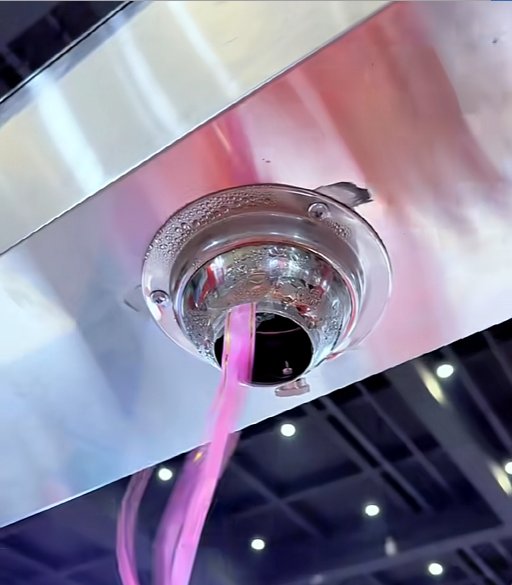
The duct carries cold air. A single-wall duct will condense heavily on its outer surface in a kitchen, and water mixed with grease dripping onto food is unacceptable. Cooyard uses a double-wall insulated stainless duct: a 201 stainless inner wall that is easy to clean and hostile to grease build-up, and an insulation layer outside that prevents condensation — so the duct can sit 20-30 cm above a work surface without dripping on it.
Details that matter at two metres
- Stainless nozzles in food-grade material, mounted at roughly two metres — the height a standing cook actually occupies. Grease does not cling, and a wipe is enough.
- Straight, level duct runs tight to the wall and ceiling, with extra fixings at every bend: better to look at, and far easier to service.
- Nozzle angle set station by station on site — one nozzle, one person. Air arrives where someone is working; it is not spent on empty floor.
Results
- Every station along the duct receives a clearly perceptible air stream.
- Supply air measures more than 15 °C below ambient at the outlet.
- Installation completed at night, with zero impact on daytime trading.
A note for older premises
Retrofits in established restaurants usually live or die on the ceiling. Surface-mounted ducting along the wall and ceiling can be completed within a day and avoids opening up an existing ceiling — which is often the only way to cool a restaurant that cannot afford to close. Send us photos of your kitchen and we will tell you which route is feasible.

